top of page
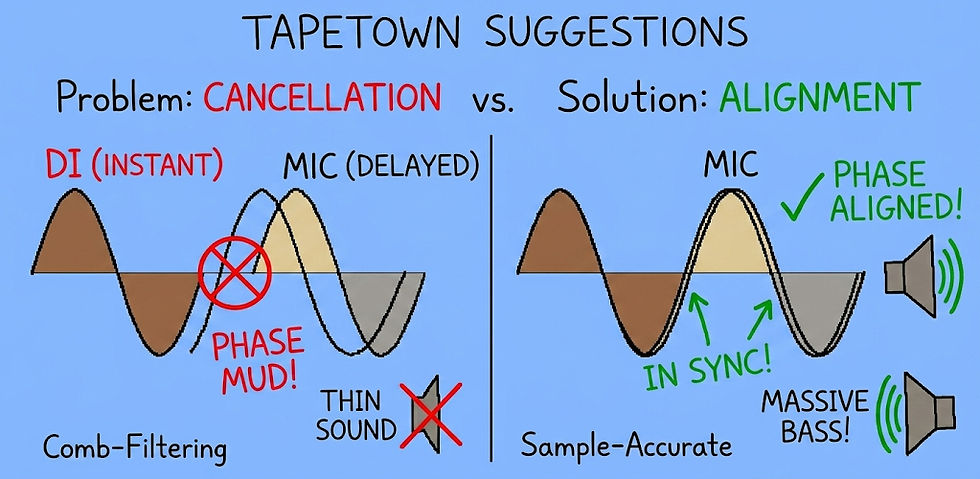
Blue audio diagram: cancellation from DI and delayed mic causes phase mud and thin sound; aligned mic gives sample-accurate bass.

When capturing a live rock or alternative performance, the bass guitar is arguably the most critical anchor on the stage. It is the bridge between the rhythmic pulse of the kick drum and the harmonic structure of the electric guitars. To ensure maximum flexibility in the mix, professional live engineers will almost always capture two separate signals from the bass player: a direct electrical feed from a DI (Direct Injection) box, and an acoustic feed from a microphone placed in front of the bass amplifier.


  • The Problem: When you open your digital audio workstation (DAW) and blend these two raw tracks together, the bass guitar often sounds incredibly thin, hollow, and weak. Instead of a massive, unified wall of low-end, you get a "phasey," nasal tone that lacks the power to drive the rhythm section.

  • The Physics: An electrical signal travels through a DI cable at nearly the speed of light. Acoustic sound waves pushing out of a speaker cabinet travel through the air at roughly 1,130 feet per second. Because the microphone is physically distanced from the speaker cone, the acoustic signal arrives at the recording interface a fraction of a millisecond later than the DI signal. This microscopic time difference causes devastating acoustic comb-filtering.

  • The Fix: You cannot fix a time-based physics problem with a frequency-based equalizer. You must zoom into the waveforms at the sample level within your DAW and physically drag the microphone track backward in time until its transient peaks perfectly align with the instantaneous transients of the DI track.

  • The Tapetown Advantage: How treating these perfectly aligned, sterile digital signals as a unified instrument and driving them into a physical analog summing mixer introduces complex harmonic saturation, creating the 3D depth and grit that defines a professional live record.


The Two Halves of the Bass Guitar

To understand why a live bass recording fails, you must understand why we capture two signals in the first place. A DI box intercepts the raw electrical signal directly from the bass guitar before it ever hits the amplifier. This DI signal is clinically clean, capturing the instantaneous transient "clack" of the bassist's fingers or pick hitting the strings, as well as the pure, unadulterated sub-frequencies (down to 40Hz). However, a DI signal is completely sterile; it lacks the grit, distortion, and physical character of rock music.

The amplifier microphone, on the other hand, captures the roaring, physical sound of the 8x10 speaker cabinet pushing air on the stage. It captures the tube distortion of the amp head and the aggressive low-midrange growl that allows the bass to cut through the electric guitars. The goal of the mix engineer is to blend the deep, clean sub of the DI with the aggressive, distorted growl of the amplifier.


The Speed of Sound and Acoustic Delay

The destruction of the live bass tone happens entirely in the physical air between the speaker cone and the microphone capsule. Sound travels through the air at approximately 343 meters per second (roughly 1 foot per millisecond).

When the bassist plucks a string, the electrical signal travels down the cable, through the DI box, and into your digital converter instantaneously. However, the sound blasting out of the amplifier takes physical time to travel across the stage. Even if the microphone is jammed right against the metal grille cloth of the amplifier, the capsule might still be one or two inches away from the actual paper speaker cone inside the wooden cabinet.

This physical distance means the microphone captures the sound a fraction of a millisecond later than the DI box. If the microphone is backed off the cabinet by a few feet to capture more of the room, that delay increases to several milliseconds.


Comb-Filtering: The Invisible Frequency Killer

A delay of one or two milliseconds might seem imperceptible to the human ear, but when you combine the instantaneous DI track with the delayed microphone track, the mathematics of the waveforms collide.

Because the two audio waveforms are slightly offset in time, their peaks and valleys no longer line up. At certain low frequencies, the peak of the DI waveform will occur at the exact same moment as the valley of the microphone waveform. When your computer sums these two opposing values together, they mathematically cancel each other out. This acoustic phenomenon is called comb-filtering.

As thoroughly detailed in deep technical breakdowns of phase relationships like Phase Demystified, comb-filtering physically deletes random frequencies from your recording. It literally sucks the fundamental low-end energy completely out of the bass guitar, leaving you with a hollow, honky, and weak tone. If you attempt to fix this by simply boosting the bass on an equalizer, you will only amplify the chaotic, phase-canceled frequencies, resulting in a muddy, undefined mess.


The Fix: Sample-Accurate Phase Alignment

To restore the massive low-end of your live bass recording, you must correct the physics of the acoustic delay. This requires manual, surgical precision in your DAW.

First, find a section of the recording where the bassist plays a sharp, staccato note with a clear, defined transient attack (a heavy pick strike or a "slap" works best). Zoom vertically and horizontally into the waveforms until you are looking at the actual individual digital samples.

You will clearly see that the transient spike of the DI track happens before the transient spike of the microphone track. Disable the "snap-to-grid" function in your DAW. Click on the microphone audio region and manually drag it backward in time, shifting it to the left until its initial transient peak perfectly aligns with the transient peak of the DI track.

When these two waveforms are perfectly in phase, the speaker cones in your studio monitors will push forward simultaneously. The massive, fundamental sub-frequencies will instantly reappear. The bass will sound incredibly thick, punchy, and unified without you ever touching an equalizer or a compressor. Mastering this invisible alignment is the foundational step in professional Mixing Bass.


The Tapetown Advantage: Analog Summing for 3D Depth

Once you have achieved a perfectly phase-aligned bass blend in the digital domain, you will have a thick, clean low-end. However, perfectly aligned digital math can sometimes feel too clinical and sterile for a raw live rock performance.


To breathe life, grit, and physical dimension back into the instrument, we apply the principles from The Analog vs. Digital Paradox: A Masterclass in Modern Sonic Authority. At Tapetown, we route the perfectly aligned DI and microphone tracks out of the computer and drive them simultaneously through a discrete analog summing mixer or a pair of heavy hardware transformers.


The physical analog circuitry reacts completely differently than digital summation. Pushing the heavy low-end voltage into a physical transformer generates subtle magnetic saturation. This naturally compresses the errant transients and generates dense, even-order harmonic distortion. The analog hardware acts as an acoustic glue, permanently bonding the clinical sub-frequencies of the DI with the aggressive, roaring midrange of the amplifier.

This saturation thickens the instrument, pushing it forward on the 3D soundstage and allowing it to lock perfectly with the kick drum. By mastering the invisible physics of acoustic delay and embracing the harmonic authority of analog hardware, you transform two disconnected, weak signals into a massive, driving physical force that anchors the entire live record.


References & Further Reading


Hand-drawn poster reading Indie Mixing in the AI Era, with a stick figure at a mixing console, robot heads, and audio waveforms.

Indie mixing in the AI era is about more than making a song sound clean, loud, and balanced. It is about protecting the human character of the recording: the performance, the tension, the flaws, the room, the dynamics, the noise, the emotion, and the feeling that real people made something together.

AI can generate polished music quickly. But polish is not the same as identity. For indie, alternative, post-punk, shoegaze, punk, psych, noise rock, dream pop, and guitar-based music, the best mix is not always the most perfect mix. It is the mix that makes the song feel alive.

That is where human mixing still matters.


The new problem for indie artists

For years, the biggest challenge for independent artists was access.

You needed access to a studio.Access to expensive equipment.Access to experienced engineers.Access to mastering.Access to distribution.

Now a lot of that has changed. Bedroom recording is normal. Affordable interfaces sound good. Digital tools are powerful. AI music platforms can generate complete songs from simple prompts. Automated mastering can make a track loud in minutes.

The problem is no longer just: “How do I make something that sounds professional?”

The problem is becoming:


How do I make something that sounds like me?

When everyone can access polish, polish stops being rare. When everyone can generate something clean, clean stops being memorable. When the internet fills with music that sounds finished but anonymous, the real value moves somewhere else.

The value moves toward personality.


Indie music should not sound too perfect

A lot of indie music becomes weaker when it is mixed like commercial pop.

That does not mean pop mixing is bad. Pop mixing is an art form. But the priorities are often different. Pop mixing often rewards tight editing, bright vocals, controlled low end, perfect timing, clean separation, strong loudness, and instant impact.

Indie and alternative music often need something else.

They need friction. They need atmosphere. They need danger. They need width without sterility. They need a vocal that feels emotionally close, not just technically clear. They need drums that feel played, not assembled. They need guitars that have mass, not just fizz. They need a low end that supports the song without turning it into a plastic product.

A good indie mix does not remove the human element. It frames it.


What makes a mix sound human?

A human-sounding mix is not simply a messy mix. It is not a bad recording. It is not an excuse for poor quality.

A human mix is a mix where the emotional information survives the production process.

That can mean:


  • Keeping small timing differences that make a band feel like a band.

  • Letting room sound and bleed create glue.

  • Choosing a vocal tone that reveals the singer, not just the microphone.

  • Avoiding over-editing drums until they lose movement.

  • Using compression for energy rather than just control.

  • Letting guitars occupy a physical space instead of flattening them into a wall of identical frequencies.

  • Allowing quiet sections to be quiet, so loud sections actually feel loud.

  • Making decisions based on feeling, not only meters.


The human part of a record often lives in the details most automated systems are trained to smooth out.


AI can imitate genre. It cannot understand your intention.

An AI system can imitate the surface of indie music. It can generate jangly guitars, washed-out vocals, post-punk basslines, shoegaze textures, lo-fi drums, or nostalgic synths.

But a genre is not an identity.

Your identity is in the reason the song exists. It is in the lyric you almost did not write. It is in the drummer pushing the chorus slightly harder. It is in the guitarist’s ugly tone that somehow makes the whole song work. It is in the moment where the vocal cracks and suddenly the line becomes believable.

A human mix engineer listens for those moments.

The job is not just to make every element “better.” Sometimes the job is to know what should not be fixed.


The danger of the “perfect average” mix

A lot of modern production tools push music toward the same center point.

Cleaner tuning.Tighter timing.Less noise.More brightness.More loudness.More separation.More low-end consistency.More instant clarity.

Those things can be useful. But if every decision moves the song toward the same version of “professional,” the result can become emotionally average.

This is especially dangerous for indie music.

Indie music often works because it has a point of view. It is not trying to be everything to everyone. It is trying to feel specific. A slightly strange snare, a dark vocal, an overdriven bass, a noisy guitar, or an uncomfortable room sound can become the thing that makes the song memorable.

A human mix protects that.


What an indie mix engineer actually does

A good indie mix engineer is not just a technician. They are a translator.

They translate the raw recording into a finished record without losing the original reason the song mattered.

That means asking questions like:

What is the emotional center of the song?Should the vocal feel intimate, aggressive, buried, dreamy, exposed, or confrontational?Should the drums feel tight, explosive, trashy, roomy, dry, or unstable?Should the guitars feel wide and beautiful, or narrow and dangerous?Should the bass be clean and supportive, or distorted and physical?Should the song feel modern, nostalgic, raw, cinematic, claustrophobic, or live?

These are not just technical questions. They are identity questions.


Why analogue and hybrid mixing still matter

Analogue gear does not automatically make a song better. A bad decision through expensive equipment is still a bad decision.

But a hybrid analogue workflow can be powerful for indie music because it introduces physical behaviour into the mix.

Analogue saturation, compression, EQ, tape-style movement, transformer colour, room re-amping, and hardware gain staging can make a track feel less flat and less plastic. They can add density, movement, harmonic complexity, and emotional weight.

The important thing is not nostalgia.

The important thing is resistance.

Digital tools often allow infinite correction. Analogue tools force decisions. You listen, commit, react, and move forward. That kind of process can be good for music that depends on instinct and character.


How to make your indie song stand out

If you are making indie or alternative music now, the question is not simply: “How do I compete with AI?”

The better question is:

What can my music do that generated music cannot?


Here are the areas worth focusing on.


1. Make the performance matter

A song feels more human when the performance carries information.

Do not record everything as if it can be fixed later. Rehearse the arrangement. Decide where the energy rises and falls. Let the drummer, bassist, guitarist, and vocalist respond to each other. Even if you record at home, think like a band.

The mix can enhance performance, but it cannot invent chemistry that was never there.


2. Keep some real dynamics

If every section of the song has the same intensity, nothing feels dramatic.

AI-generated and over-produced music often feels impressive at first because everything is constantly full. But human listeners connect with contrast. Let verses breathe. Let choruses arrive. Let breakdowns feel smaller. Let the last chorus earn its size.

A good mix does not just maximize volume. It shapes movement.


3. Choose emotion over perfection

The best vocal take is not always the cleanest take. The best guitar tone is not always the most expensive tone. The best drum sound is not always the most isolated drum sound.

Ask what makes the listener believe the song.

If a technically imperfect element makes the song feel more real, it may be worth keeping.


4. Build a sonic world

A strong indie mix creates a world around the song.

Is the song happening in a basement?A huge room?A club?A dream?A rehearsal space?A broken radio?A cinematic landscape?A dry and confrontational close-up?

The mix should not feel like separate tracks placed next to each other. It should feel like a place the listener can enter.


5. Avoid generic reference chasing

References are useful. But copying references too closely can erase identity.

Use reference tracks to communicate energy, low end, vocal level, width, or attitude. Do not use them as a recipe. Your song might need a different kind of darkness, brightness, dirt, or space.

The goal is not to sound like your favourite record.

The goal is to understand why you love that record, then find the version that belongs to your song.


6. Let the mix have a point of view

A memorable mix has opinions.

Maybe the vocal is buried because the track should feel mysterious.Maybe the snare is too loud because the song needs violence.Maybe the bass is distorted because the low end should feel dangerous.Maybe the guitars are washed out because the lyric needs distance.Maybe the room mics are exaggerated because the band should feel larger than life.

A safe mix rarely becomes a loved mix.


When should you hire a human mix engineer?

You should consider hiring a human mix engineer when:


  • The song matters enough that you do not want a generic result.

  • You have a strong rough mix but cannot make it feel finished.

  • Your home recording has good performances but lacks depth and weight.

  • Your drums sound flat or disconnected.

  • Your guitars sound smaller than they felt in the room.

  • Your vocal is either too exposed or too buried.

  • Your song sounds technically fine but emotionally wrong.

  • You are making an EP or album and need a consistent sonic identity.

  • You want the track to feel like a record, not just a file.


Automated tools can be useful for demos, quick tests, and rough releases. But if the song represents your artistic identity, human mixing is still one of the most valuable stages of the process.


The future of indie music is not anti-technology

The point is not to reject AI, plugins, editing, or digital tools.

The point is to know what they are for.

Technology can help artists work faster. It can remove barriers. It can clean up problems. It can open creative doors. But it should not replace taste, intention, performance, and emotional judgement.

The future of indie music will not belong to the artists who sound the most perfect.

It will belong to the artists who sound the most unmistakable.


Indie mixing in the AI era is not about fighting machines. It is about remembering what machines are bad at.

They are bad at meaning.They are bad at commitment.They are bad at knowing why the wrong sound is sometimes the right sound.They are bad at protecting the fragile, strange, human thing that made the song worth recording in the first place.

That is the job of a human mix.

Not just to make the song sound better.

To make it feel more like itself.


Related reading


If you want to go deeper into the ideas behind this article, start here:


Updated: Jul 6


Empty modern gallery with suspended pastel blocks, glossy floor, and a distant display counter under warm blue-pink light

The safety net is real. What it costs you is more real.


Let's be honest about the technology before we indict it. 32-bit float recording is a genuine technical marvel. The dynamic range is so vast as to be essentially infinite for any practical recording application. You cannot clip it at the input stage. You can record a drummer playing at full volume, realise you had the gain forty decibels too high, pull it back in post, and retrieve a usable take. This is real. It works. It is not marketing.

And it is making engineers worse. Not obviously worse, not in ways that show up as clipped takes or distorted vocals. Worse in the way that matters more: in attention, in decision-making, in the quality of listening that separates an engineer who captures something extraordinary from one who simply administers a session and hands over the files.

Here is the mechanism.


Gain staging is not a technical chore. It is a musical decision.

When you set the gain on an input, whether that is an analogue preamp, a console channel, a standalone microphone preamplifier, you are not performing housekeeping. You are making a choice about where in that circuit's character this sound is going to live.

A signal hitting a transformer-coupled preamp at the top of its headroom behaves differently than the same signal at half that level. The harmonics change. The way the circuit responds to transients changes. The sound has a different relationship to the noise floor, to the saturation curve, to the particular personality that a piece of equipment took decades of engineering and manufacturing to develop. These are not subtle differences. They are audible to anyone who has spent real time listening, and they are absolutely gone if you decide you will sort the level out in post.

The 32-bit float engineer sets gain somewhere in the ballpark and moves on. There is no consequence for the wrong choice, so there is no pressure to make the right one. Over time, over hundreds of sessions, the muscle that makes that decision stops developing. The ear that knows where a signal should sit in a circuit stops being trained. You get engineers with excellent recall of plugin parameters and a diminishing ability to hear what is actually happening in a room.


The safety net changes your posture before you touch a single fader.

There is a psychological dimension to 32-bit float that nobody in the gear conversation wants to discuss, because the gear conversation is about specifications and the psychological dimension is about character.

When you know you cannot make an unrecoverable mistake at the gain stage, you stop being fully present to the gain stage. Your attention, which is the most valuable thing you bring to a session, quietly relocates. You start thinking about the mix, about the session schedule, about the conversation you need to have with the band about the arrangement in the third song. The input gain becomes something you will revisit later rather than something you are deciding now.

This is not a criticism of individual engineers. It is a description of how humans respond to the removal of consequences. Every safety net ever invented has produced this effect in its domain. The question is not whether the effect happens, it does, reliably, in every field where it has been studied, but whether you are aware of it happening to you and whether you are choosing to compensate for it.

Most engineers using 32-bit float recorders are not aware. The sessions do not fail. The takes are clean. The files come back with headroom and nothing peaking and nothing wrong, exactly, and something slightly not right that nobody can put their finger on and that everybody agrees is probably down to the performance or the room or the arrangement or the day.

It is usually the gain staging.


You can recover the waveform. You cannot recover the sound.

Here is the version of this argument that engineers who defend 32-bit float will dismiss as mysticism, and here is why they are wrong.

When a signal is hitting a preamp hard, when it is working, when the circuit is under pressure, when the transformer is at the edge of its linear range, it is producing harmonic content. Second-order harmonics, primarily, the even-order distortions that the human ear does not register as distortion but as presence, as warmth, as the quality that makes certain recordings feel three-dimensional in a way that technically cleaner recordings do not. That harmonic content is generated by the interaction between the signal level and the circuit. It exists at the point of capture or it does not exist at all.

When you record at the wrong level and pull it back in post, you are not recovering the sound. You are recovering the amplitude information about the sound. The harmonic story the preamp would have told if you had driven it correctly, that story was never written. What you have is a clean, uncoloured, dynamically accurate, slightly dead recording of a signal that was not allowed to do what it was going to do.

This is the core of the problem. 32-bit float promises that no information will be lost. What it cannot promise, what no digital system can promise, is that the information you needed was ever captured in the first place.


The engineers who developed real ears learned on systems that punished them.

The engineers whose work you admire, the ones with genuine discernment, the ones who can hear what a room is doing before a note is played, who know within seconds of a singer opening up whether the mic choice is right, who can feel a session going sideways before it goes sideways, those engineers learned on systems where a wrong gain decision was immediate, irreversible, and expensive.

They clipped takes. They salvaged what they could. They listened to the difference between a take captured at the right level and a take captured at the wrong one, and they did not get to pretend the difference did not matter because they had a 32-bit safety net to hide it. They had to hear it, sit with it, understand it, and make sure it did not happen again.

That is not nostalgia. That is a description of how expertise is built in any craft that involves physical systems and real consequences. You learn what the system does by feeling what happens when you push it wrong. Remove the consequence and you remove the lesson, permanently, for every engineer who will never experience it.

We are now training a generation of engineers who are technically proficient, who understand signal flow, who can operate a DAW with considerable skill, and who have ears that have never been sharpened by a real mistake. The takes are clean. Nothing is obviously wrong. And the recordings are missing something that nobody can quite name.


The answer is not to throw away your recorder.

Tapetown does not operate on a principle of deliberate technical primitivism. We use modern equipment. We use converters with performance that would have been unimaginable twenty years ago. The argument here is not about bit depth.

The argument is about posture. About where your attention is when the session is running. About whether the act of setting gain is a decision you are making or a step you are completing. About whether the safety net is something you are aware of and consciously working against, or something you have simply accepted as the natural condition of modern recording.


Make decisions. Commit to them. Set the gain where it should be and know why it should be there. If you are using a 32-bit float recorder, use it the same way you would use a system that costs you the take if you get it wrong, because the cost is still there, it is just hidden, and it is paid later, in the quality of the recording, in the life of the sound, in the thing that listeners feel but cannot name when they say a record sounds a little flat, a little safe, a little like something was not quite committed to.


Commit. That is the job. The bit depth is not an excuse.

Finishing a record? Send us the rough mix.

bottom of page